Lost Eyes
You are rejected! Rejection is hardly bearable. Isn’t it? You are standing at the corner of a crowded marketplace; yet some extreme loneliness pervades through the core of your realisation. Your eyes are open. But all the constricted fabric of your heart is so much preoccupied that you barely see whatever you are staring at. People pass by like blurred dualities in your lost eyes.
Hey! Do you see, there are two heads of each person in front of you?
“What?”
Back to your mind, you start precisely looking at things and everything is as usual now. But still you see two copies of most of the things in front of you.
“What nonsense are you speaking?”
You utter in disgust. Well, I understand. Your grudge is welcome. But you have to come out of whatever nonsense you are bogged down in. I am with you now and you shall accept the reality soon. Be it whatever staggering a rejection is hurling you or be it the fact that you see two copies of things in front of you. Yes, I am absolutely sane to assert you.
“If you are so caring, then return the time I have lost and stop saying about what I see.”
Become the master of space to claim time back. Time lost in the unwanted past will come back as precious lessons in the future. You have to be the person to digest it. I am going to show you that what you see in space delivers more to you. More, to get your time back. So, let us start considering our experience in space. Join me?
“Well, be it. I have started appreciating your rhetoric.”
Mind the reader please! Let’s walk for a while. Anyway, time is intangible in the sense that it is a dimension. Should you claim a return of some dimension in space? However, we are going to reclaim the third dimension itself.
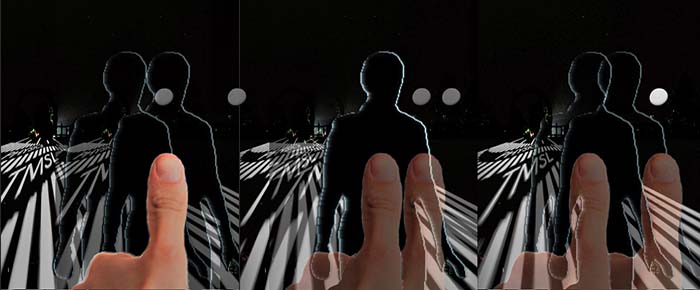
Look at the screen, the left figure is you looking at the horizon with your lost eyes and in the right figure you are looking at something very close to your forehead with crossed eyes.

What do the figures tell you? You move your left and right eyes in opposite directions horizontally to aim at things at different distances. A camera does not do the same. It just focuses.
“Why eyes do then?”
Because a camera records images with equal importance at every point of the sensor. But human eyes stare at a certain point (name it P) so that its image is formed at the macular centre of retina, where sensitivity is the highest. This centre is the origin of the retinal 2d space in both of our eyes. That is why P forms its image at the same coordinate in both of your eyes. And you see a single P. But objects other than P do not form images at the same coordinates of both retinas. Guess why?
“Two eyes are at different positions, so they must form different compositions of images. Okay?”
Right. But do you feel the very difference in compositions?
“No. Strange! Why don’t I feel it?”
You feel it, believe me! But you do not feel it as a problem. We all perceive this disparity as the third dimension. You cannot pass a thread through the eye of a needle with one of your eyes closed. Because a precise 3D coordinate is necessary for the job. And a single-eye image lacks the information of the third dimension. So, it is possible to encode the third dimension in the disparity of two 2D images. And we can engineer this principle to envisage various creative arts!
“Engineering? Are you serious?”
Nope. Call it otherwise. After all, safe drive saves life. But to enjoy the amazing creativity possible with this understanding, you need to play with practical experiments and projects.
“Are you going to play with organs like eyes?”
Absolutely not. I would do rather with viewing. If you understand how the brain forms each 3D image from two 2D inputs, you can create images and enjoy the fun. Let’s have a go.
Two Moons in the Sky
It’s quite dark now. Place your thumb at one foot distance in the front. Shed the mobile LED on it. And I stand six feet away. The moon is behind me. Look at the illuminated thumb and keeping your eyes there, try to feel what the moon looks like. However, never aim your eyes at the moon.
“I see! There are two moons!”
Good. Now look at me and feel the moons.
“The moons are a bit close now. But the thumb has got doubled. So, your head is at my retinal centre? And if I look at the moon… Oh, everything else is double! Brill! What a realisation!! But why haven’t I noticed it earlier?”
Now you are asking, why not earlier! See, your time is returned in contrast with the present.
“Ta, you have opened my eyes!”
Mind the reader. They already have open eyes. So, when you aim eyes at me, all objects in the background like the moon and foreground like your thumb fall apart as two copies, okay? Remember the principle: the horizontal distance between the copies implies its position in the third dimension. And we are so habituated with it that we just ignore that we always see two copies of things this way.
“But how can we understand near and far with just one eye? And we do not feel any problem with a flat screen cinema also?”
Exactly. Disparity between eyes is not the only depth cue. The size matters. I can show you images later where near is smaller and far is bigger. But we are accustomed with the opposite. Nearer things are bigger. Besides, when you look at a very close thing, distant objects become blurred. Another thing is light and shadow. So, four depth cues are there:
- Disparity between retinal images
- Relative sizes
- Sharpness of objects due to focusing
- Light and shadow
Special effects in cinema take advantage of the absence of the first cue. For example, Charlie Chaplin used a brilliant Idea in Modern Times using this trick. You can read about it.
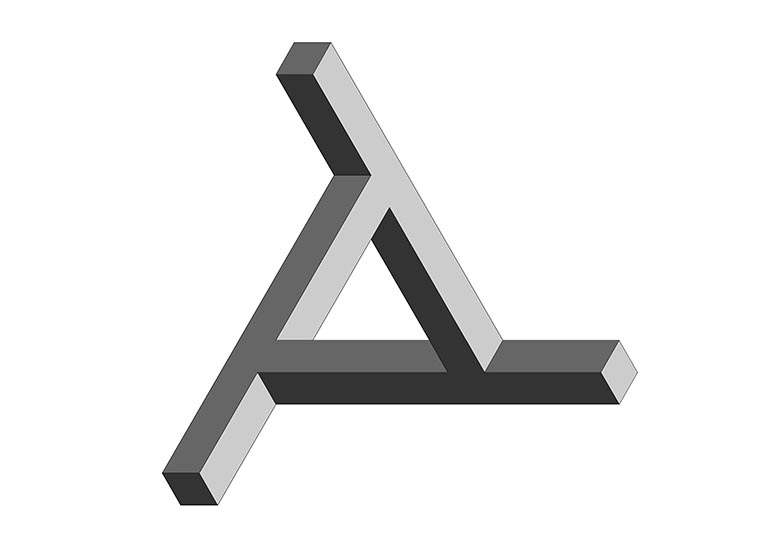
Look at the famous Penrose triangle. It exploits the paradox of the one-eyed 3D. It is an orthogonal triangular structure on a flat screen whose each of three angles is a right angle. It is impossible to present it as a real two-eyed 3D object.
“This is stunning! So, two eyes are necessary for a real 3D sense, are they? Well, but where is the creative art museum?”
Internet is flooded with them. We can start with a simple stereoscopic figure where the third dimension is encoded as the horizontal disparity between two images. You can make your own stereoscope later. But it’s possible to do with naked eyes.
Stereography
Look at the two sets of figures:
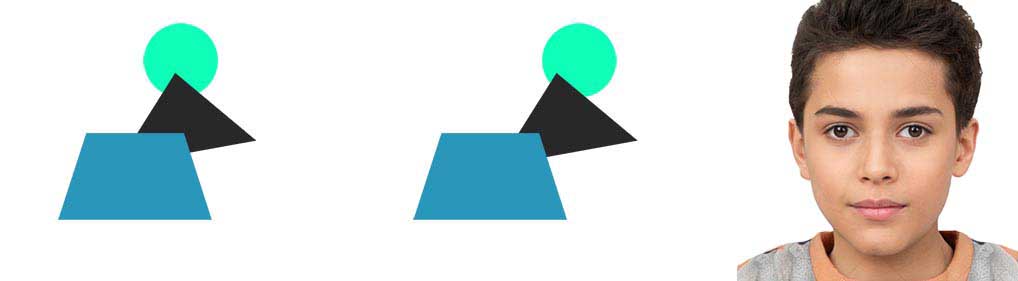
You can clearly see, the blue trapezium is covering more of the black triangle in the left set and less in the right. This is a parallel view or back view stereogram, a ‘lost eyes’ case. If we switch the left and right sets of figures then we get a crossed view or front view stereogram, a ‘crossed eyes’ case. It’s as follows:
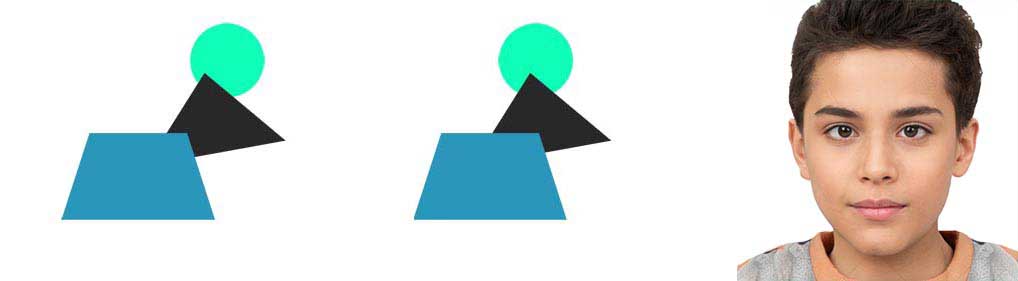
“Do not talk bookish! No one is listening to your jargons. Let me enjoy the thing. How to get a 3D from all this skirmish of left and right?”
Good. In each stereogram two similar images are there. You have to see one of them with your left eye and the other with your right eye. Remember that the top vortex of the triangle should be located at the centre of both the retinas.
“How in the world can one see with such mathematical instructions!!”
No problem, our brains are masters of mathematics. Whenever figures are fed to the eyes, the brain adjusts views automatically. One method to feed separate figures to different eyes is using a stereoscope.
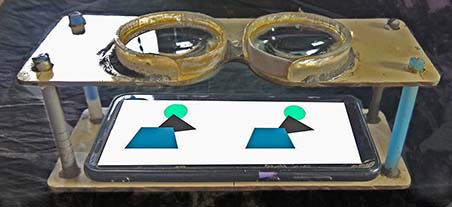
It’s a ‘lost eyes’ stereogram. If you keep the images very close to your eyes, each eye will see the image for itself. But eyes cannot focus to very close things. So, you need two lenses for clear focusing.
“I do not have any such lenses. Can you stop telling stories and show me the fun?”
Yes, I can, if you have the curiosity and patience. Just forget about the ‘crossed eyes’ case this time. We start with the ‘lost eyes’ principle. Look at the horizon. Place your two index fingers above the horizon touching each other very close to your eyes, may be at three-four inches. There must be enough light on the fingers. Do not aim your eyes on them, just stare at the horizon. Now make a 1cm gap between the fingers.
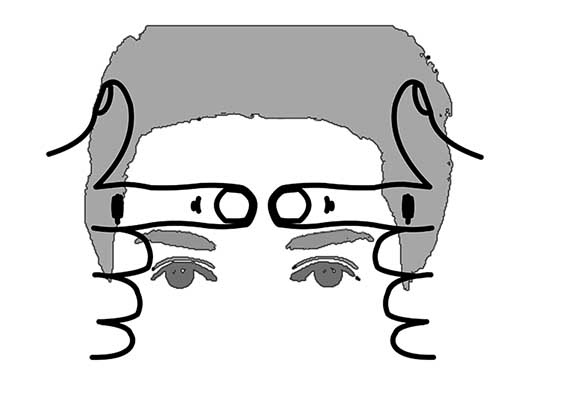
Try to feel the fingers without aiming. What do you feel?
“A to-nailed piece between the two fingers!”
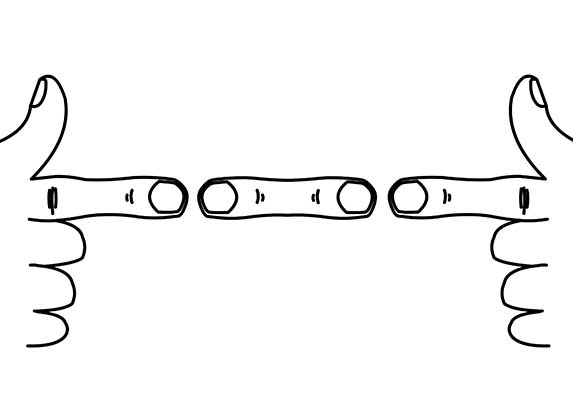
That means, if we do not aim our eyes at things near us, we can create artificial overlapping of the images in the left and right retina. Now place the ‘lost eyed’ figure at a distance of around one foot in front of your eyes. As the figures are facing you, your eyes will tend to aim at it. But relax the eyes. Do not aim the stereogram. Try to look at the horizon through the figures. It may take several attempts. But it’s not a difficult job to do. Your eyes would be looking like as shown in the same figure. And eventually the 3D sensation will appear automatically.
“Okay, let me see … … … I cannot aim the horizon through the screen!”
You may need to shrink the size of the image a little if on a computer monitor because parallel view needs a palm size dual image. A mobile phone screen in landscape mode is the best size. Then, keeping the screen at one foot from your eyes, close eyes for a few seconds and suddenly open them.
“Try, try … Gosh! What a pleasure! Is it really possible? I can clearly see how the trapezium looms so close and the circle so distant. Can you show me some more images please?”
Well, just look at this:
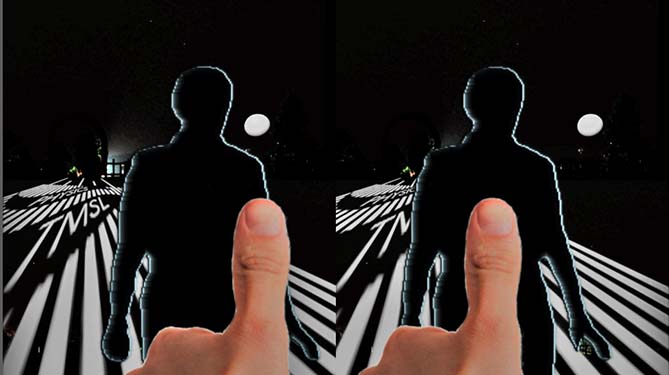
“The hand, and the person feel like cut outs.”
Right. But we can use real photographs for the purpose also. Try this one:

And some more also:



“How are these awesome photographs taken?”
Just keeping the camera at two positions 65 to 75 cm apart horizontally. You can create micro world 3Ds also by keeping macro cameras few mm apart. I can show you such an attempted micro video, however, its quality is bad…
Generally objects very far look the same for both of our eyes. So to take a 3D view of a mountain we need to increase the effective distance of our eyes, i.e., positions of the camera used. This parallel viewing 3D of Mount Khangchendzonga was taken keeping distance between camera positions around 40 feet. So you can feel the 3D topography.

“The experience is very much enjoyable. But I think, although my eyes can get me into this wonderland, it needs patience to stay there. I can’t wait for the next. What about the crossed eyed method?”
For that you need good understanding. So far you have been exercising like the man below:
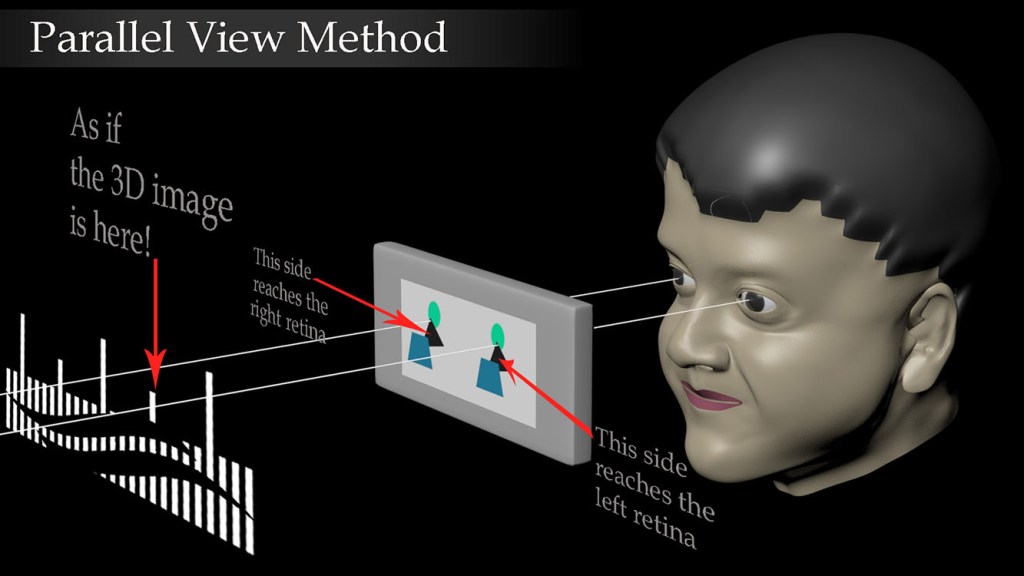
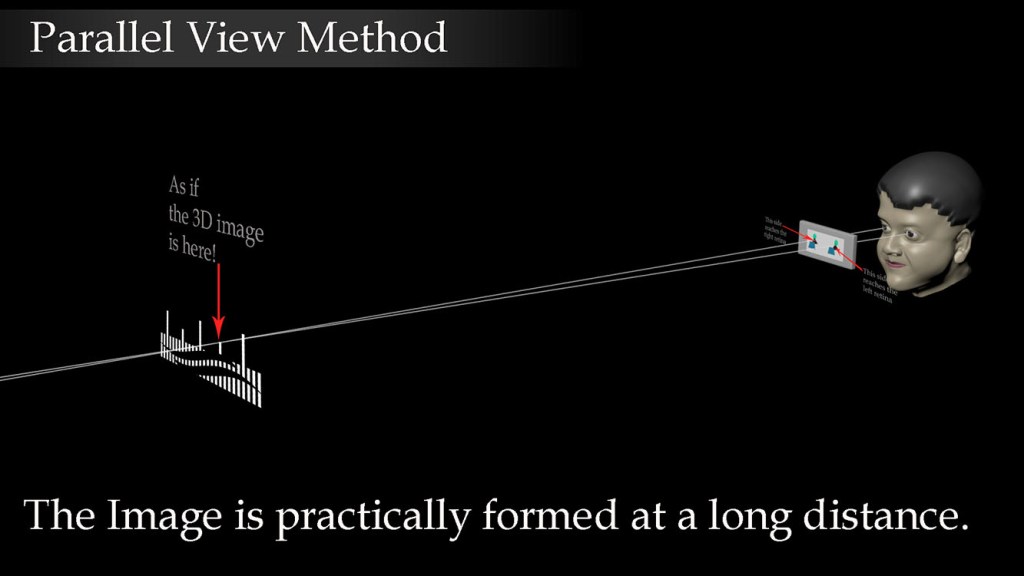
But for a crossed view method you should look at the screen as the man is doing in the next figure:

“Interesting! Where is the stereogram for this method?”
Here:
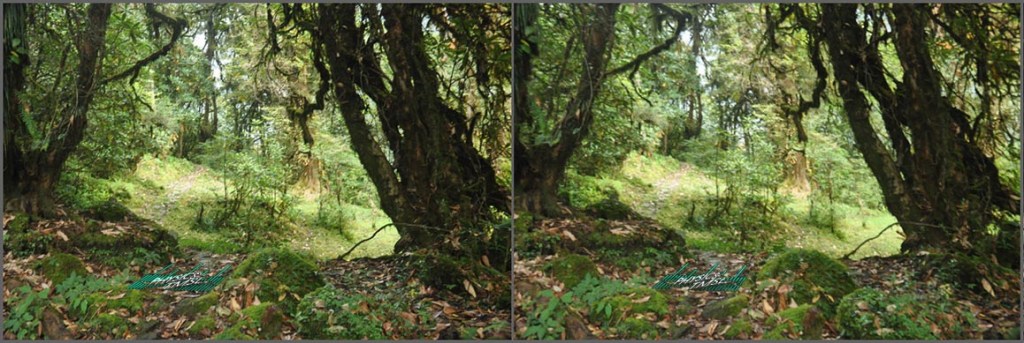
“I cannot adjust my view.”
Hold the screen at least three feet away from your eyes. Now aim your eyes at an imaginary point in the empty space half way. You can use your finger as the aiming point and move it from the screen towards you. But trying with just imagination is better.
“Well, this is interesting… it comes and goes… hold on… fine, I have entered the wonderland again! This image has a hidden beauty.”
So some crossed view 3Ds for you:




“Beautiful! I enjoy to my heart’s content. Well, what is next? Is it all your creative art?”
No. There is more to it.
Autostereogram
You have seen that for parallel view a smaller image produces better adjustment. But in crossed view it is better to have a large and distant screen. This is the fact because the two images are meant for two different eyes. But see, in the image below, you have to use the parallel view in a large screen:
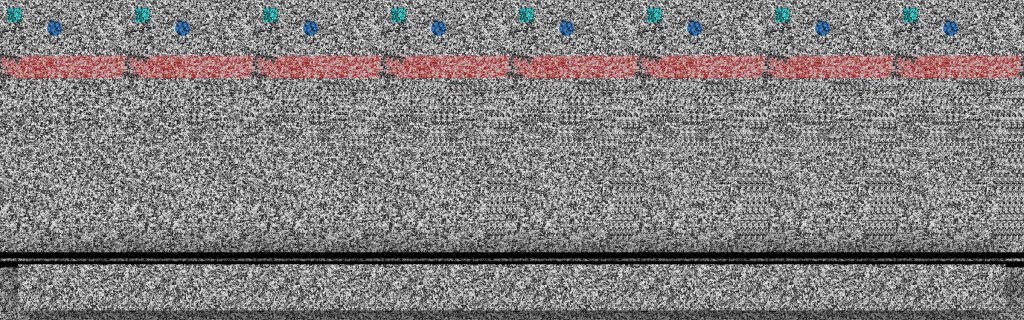
Here you apply a parallel view. Enlarge the image. Try to overlap two adjacent blue circles at the top (and the same for cyan squares) by looking at the horizon through the screen. Whenever you have a fixed and comfortable stereo view, Hold the view static for a few seconds. Then gradually move around the flat noisy backdrop in search of new things. You can see something is floating in the front. Try and let me know.
“Well, I have got the backdrop. And… yes! I see! How is it possible? The floating objects are completely invisible in plain view!”
If you use the crossed view method, the same image becomes a stencil. This type of images are sliced stereograms, called autostereograms. It is tricky. You cannot find the difference between the two images below:
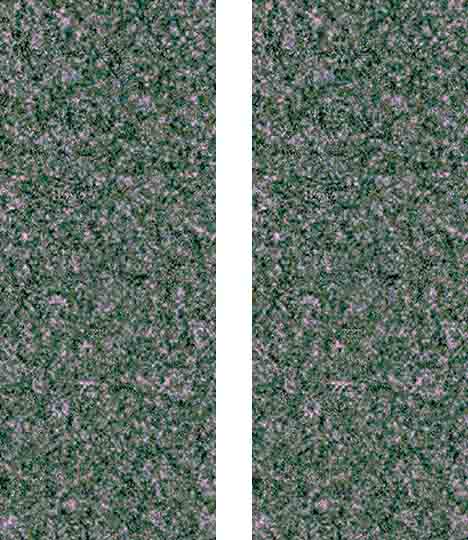
But difference is there:
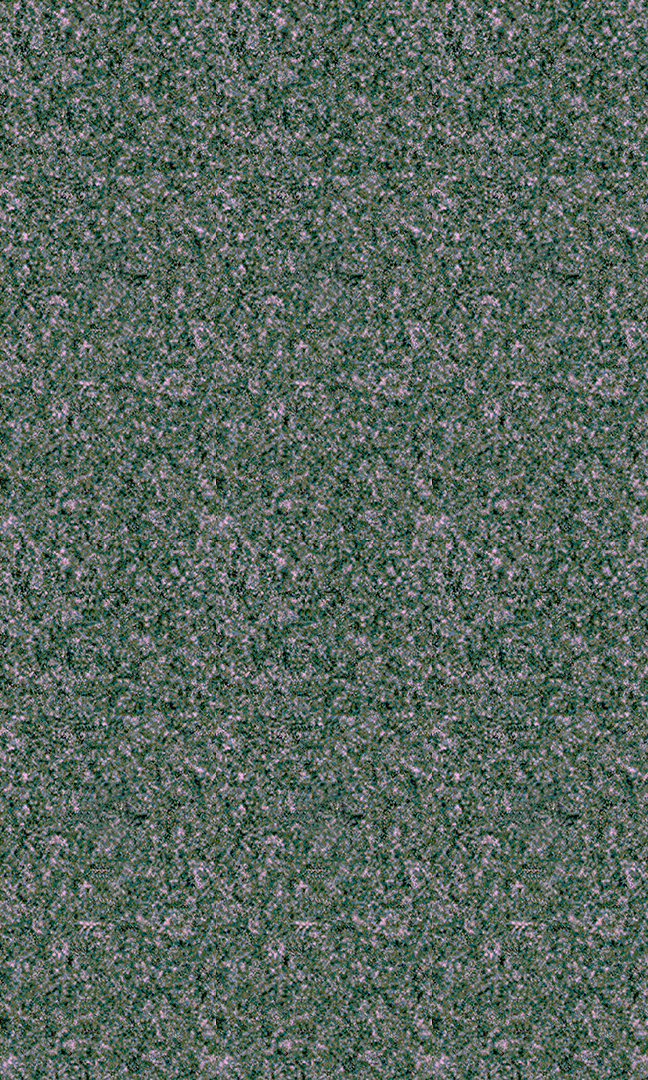
The trick is much complex. Anyway, apply the crossed view method on the next image. Merge the adjacent hills. The larger the image screen, the better the feel is. Mobile phones are not very good for autostereograms.
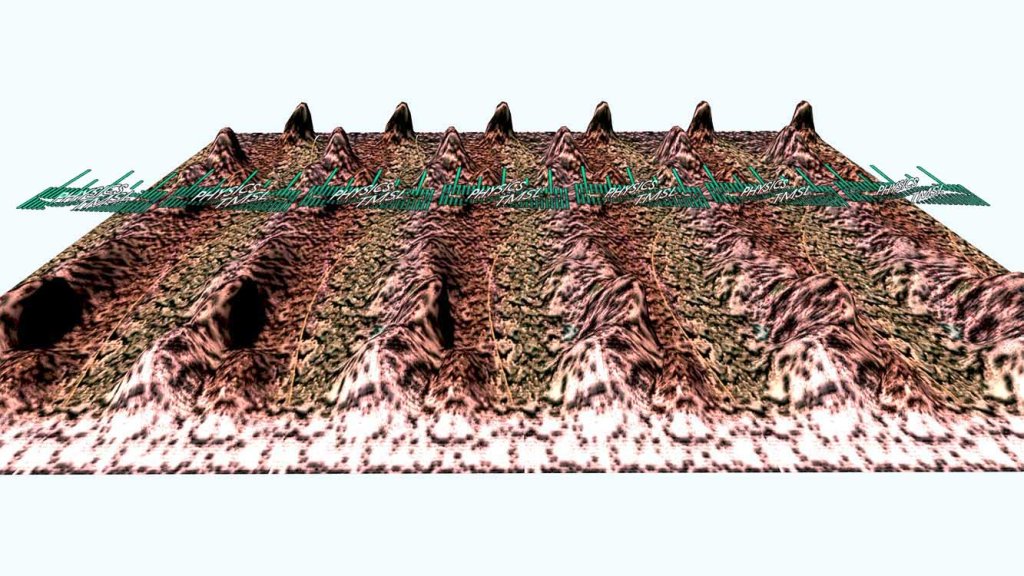
The same topography becomes a puzzling 3D in the parallel view:
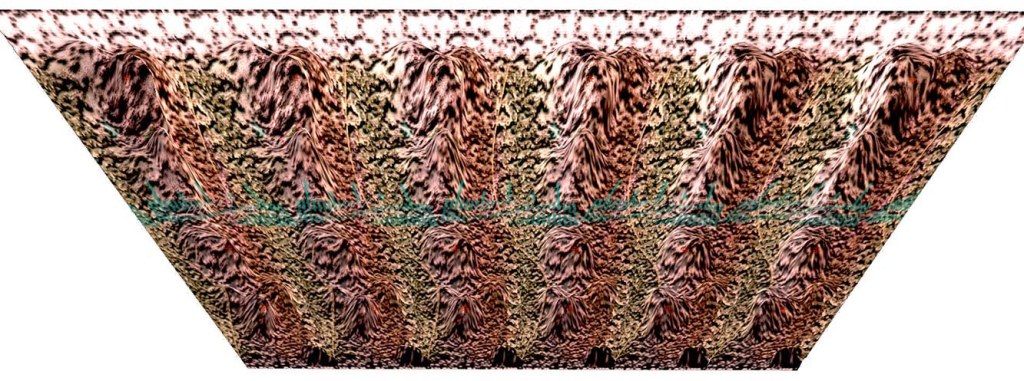
In parallel view here, far is bigger than near. The depth cue contradicts our experience.
In both of the last images some identical pattern is repeated several times with slight but significant changes. So each adjacent couple of identical things overlap and their disparity feels like the 3D. The same background is used in the next one also which is a crossed eyed 3D:
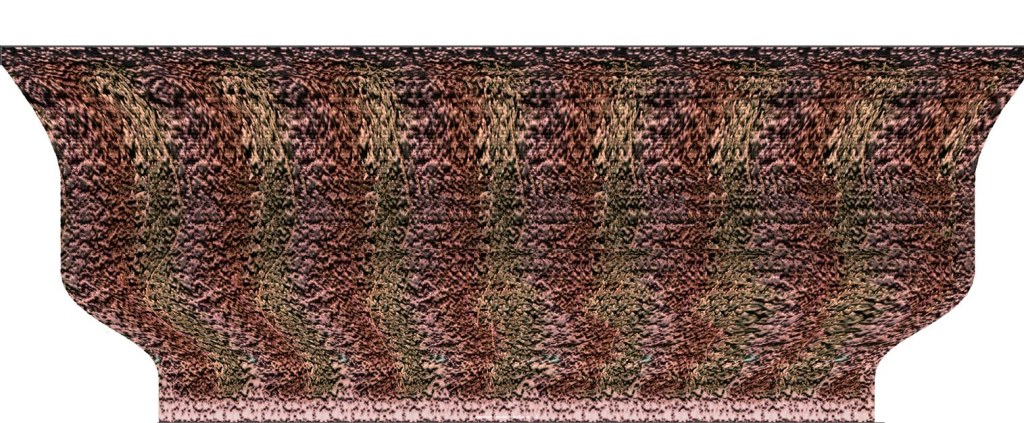
There are many interesting autostereograms available. You can easily get them in the Google search. However, I am adding three here:
Crossed View
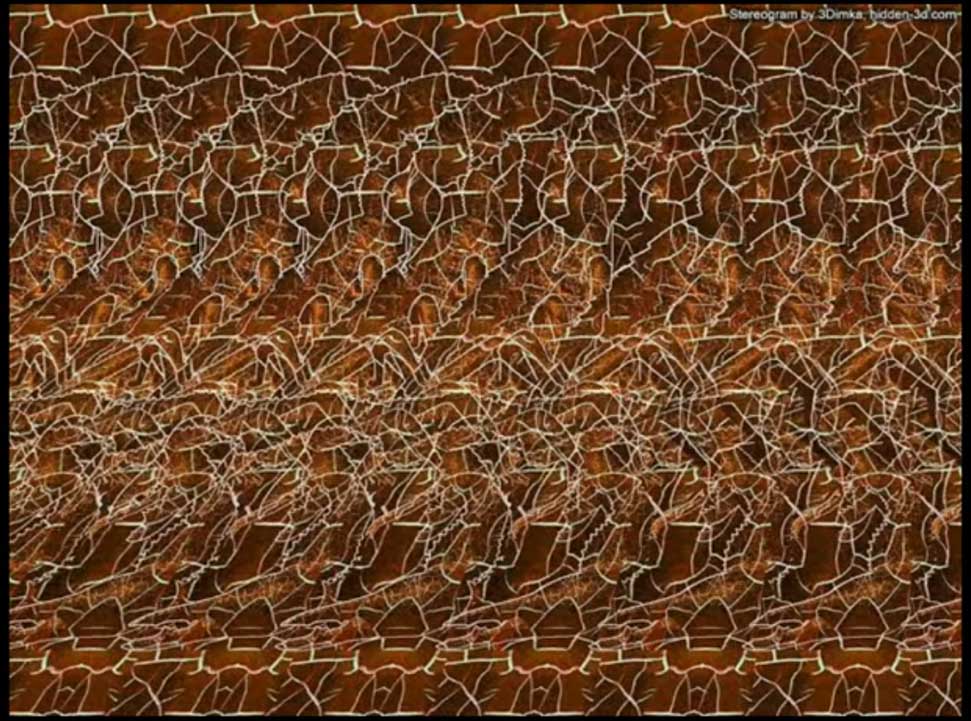
Parallel View

Parallel View
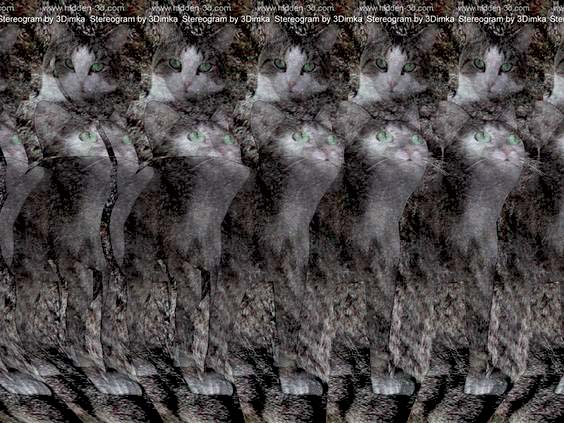
“The venture is fascinating! But one thing is poking me. You have shown me two photographs of a jungle that combine to become a 3D image. Okay. But none of the 2D frames have any 3D information in itself. My question is, does disparity, I mean uncommonness, exist? If yes, then where? Certainly not in any of the 2D images?”
Very intriguing question. You have grabbed a deep philosophical essence. We casually figure out things like common and uncommon. Tel me, what is common in the cases below:
- You and me
- Left and right
- Good and bad
- Black and white
- India and Pakistan
“Hmm… Two!”
Correct. A number does not exist itself. We have not observed a ‘2’ anywhere. But we extract ‘2’ or ‘3’ or any other natural number as something common among sets of things. Not only numbers, meaning in general does not exist outside human brain. Even values also.
And so, after all your exclamations, this venture does not bear any value itself. No good, no bad. The meaning of an image, the sense of the first, second and third dimension, and what in the world a computer can do are all mare absurdities. It’s we who find meanings. We extract what is common in the past. And we construct laws of determinism and probability in science from those common, repeating events or profiles of events.
If the case is that you are rejected, you have to fit the case in a consistent stream of history that humans have figured out. And find out your own inclusion there with both lost and crossed eyes!
 Physics TMSL