

Outcome Based Education
Following Washington Accord outcome of education is the primary consideration of learning-teaching in the department. As a basic science department Physics has to organise itself for the outcomes of several core engineering programmes. Programme Outcomes, i.e., POs are universally defined, but course outcomes, i.e., COs of the department are outlined right here to be responsive to the needs of the POs.
When writing lab COs, one keeps in mind that a CO has to be observable, measurable, serving the attainment of at least one PO and expressed with a single action verb. An optimal number of POs should be served by
the total number of BSH COs. There are well defined methods for measuring theoretical COs as well as for measuring Practical COs with a professional rubric and marking table system for continual assessment.
Programme Outcomes (PO)
After completing the programme students will be able to
PO1. Engineering Knowledge: Apply the knowledge of mathematics, science, engineering fundamentals, and engineering specialization to the solution of complex engineering problems.
PO2. Problem analysis: Identify, formulate, research literature, and analyze engineering problems to arrive at substantiated conclusions using first principles of mathematics, natural and engineering sciences.
PO3. Design/Development of solutions: Design solutions for complex engineering problems and design system components, processes to meet the specifications with consideration for the public health and safety and the cultural societal and environmental considerations.
PO4. Conduct investigations of complex problems: Use research based knowledge including design of experiments, analysis and interpretation of data and synthesis of the information to provide valid conclusions.
PO5. Modern tool usage: Create, select and apply appropriate techniques, resources, and modern engineering and IT tools including prediction and modeling to complex engineering activities with an understanding of the limitations.
PO6. The engineer and society: Apply reasoning informed by the contextual knowledge to access societal, health, safety, legal and cultural issues and the consequent responsibilities relevant to the professional engineering practice.
PO7. Environment and sustainability: Understand the impact of the professional engineering solutions in societal and environmental contexts, and demonstrate the knowledge of and need for sustainable development.
PO8. Ethics: Apply ethical principles and commit to professional ethics and responsibilities and norms of the engineering practice.
PO9. Individual and team work: Function effectively as an individual, and as a member or leader in teams, and in multidisciplinary settings.
PO10. Communications: Communicate effectively with the engineering community and with the society at large. Be able to comprehend and write effective reports documentation. Make effective presentations and give and receive clear instructions.
PO11. Project management and finance: Demonstrate knowledge and understanding of engineering and management principles and apply these to one’s own work, as a member and leader in a team. Manage projects in multidisciplinary environments.
PO12. Life-long learning: Recognize the need for, and have the preparation and ability to engage in independent and lifelong learning in the broadest context of technological change.
Course Outcomes (CO)
COs are different for courses, i.e., papers. Although there are many programmes and different semesters, one can present COs for theory and practical papers in two sets.
CO fo Theoretical Courses
Course Objectives: The objectives of Physics Course are to explain the basic concepts of mechanics, optics and its applications, electricity, magnetism and qualitative understanding of concepts of quantum physics and statistical mechanics.
After completing the course students will be able to
| CO1 | To explain the basic concepts of mechanics. |
| CO2 | To apply basic concepts of wave optics. |
| CO3 | To apply the dielectric and magnetic properties of materials. |
| CO4 | To apply the concepts of quantum mechanics in simple physical systems. |
| CO5 | To explain the basic concepts of statistical mechanics. |
CO Specific Marks Distribution
| DIRECT ASSESMENT | CO1 | CO2 | CO3 | CO4 | CO5 | TOTAL MARKS | |
| UNIT TEST 1 (15) | 5 | 5 | 5 | 15 | |||
| UNIT TEST 2 (15) | 5 | 5 | 5 | 15 | |||
| ASSIGNMENT (10) | 2 | 2 | 2 | 2 | 2 | 10 | |
| CLASS PERFORMANCE (5) | 1 | 1 | 1 | 1 | 1 | 5 | |
| INTERNAL | 30 |
CO fo Practical Courses
Course Objectives:
To explore some fundamental physical behaviours of matter and energy by measuring quantities and to interpret the same in analytical and graphical representations with estimated error values.
After completing the course students will be able to
| CO1 (Technical Skill) | utilise many a measuring equipment in usual and improvised experiments. |
| CO2 (Improvisation) | construct physical apparatus using junk material. |
| CO3 (Perfection) | estimate the accuracy of the exp. and the amount of proportional and other errors in any physical measurement. |
| CO4 (Troubleshooting) | inspect the underlying physical laws of heat, optics, electricity and mechanics in natural and artificial phenomena for problem solving. |
| CO5 (Team Work / Reporting) | organise a concise report of an experiment individually and also in a group sharing data for analytical and graphical results. |
Learning -Teaching Activities and Assessment:
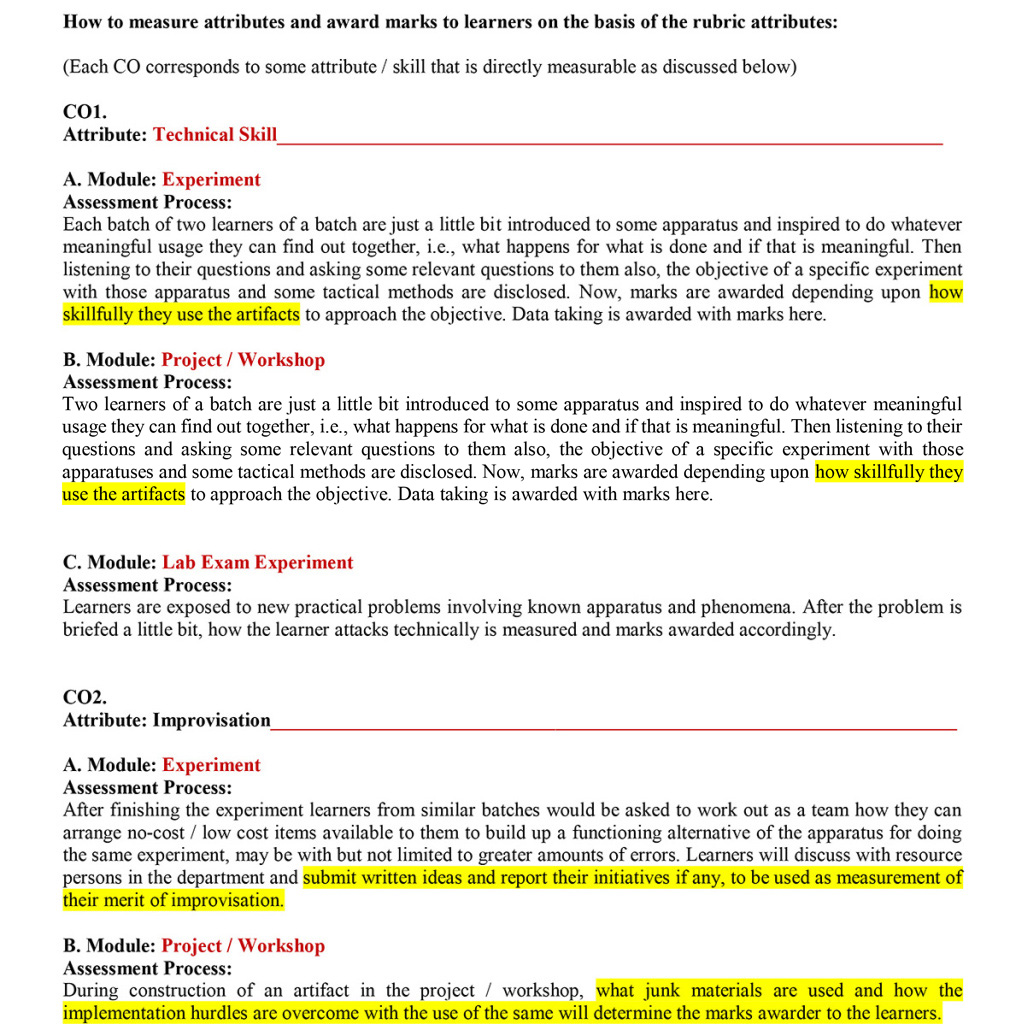
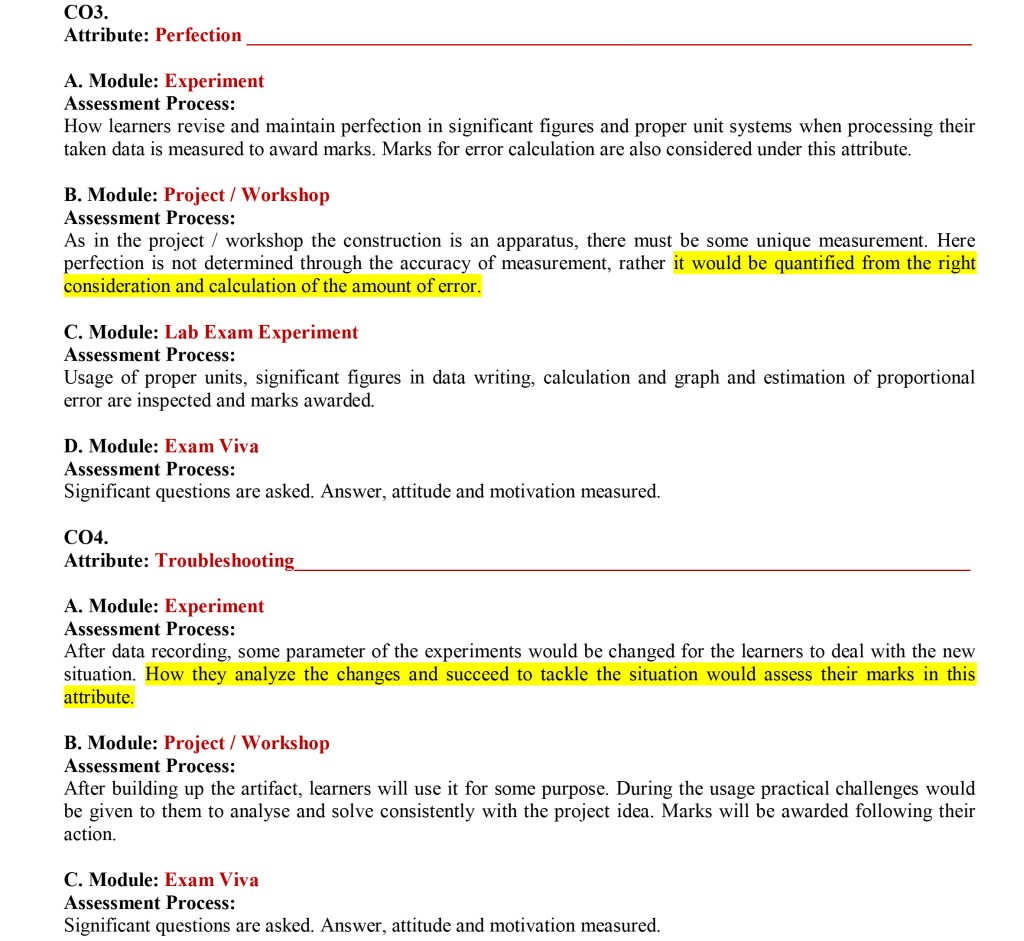
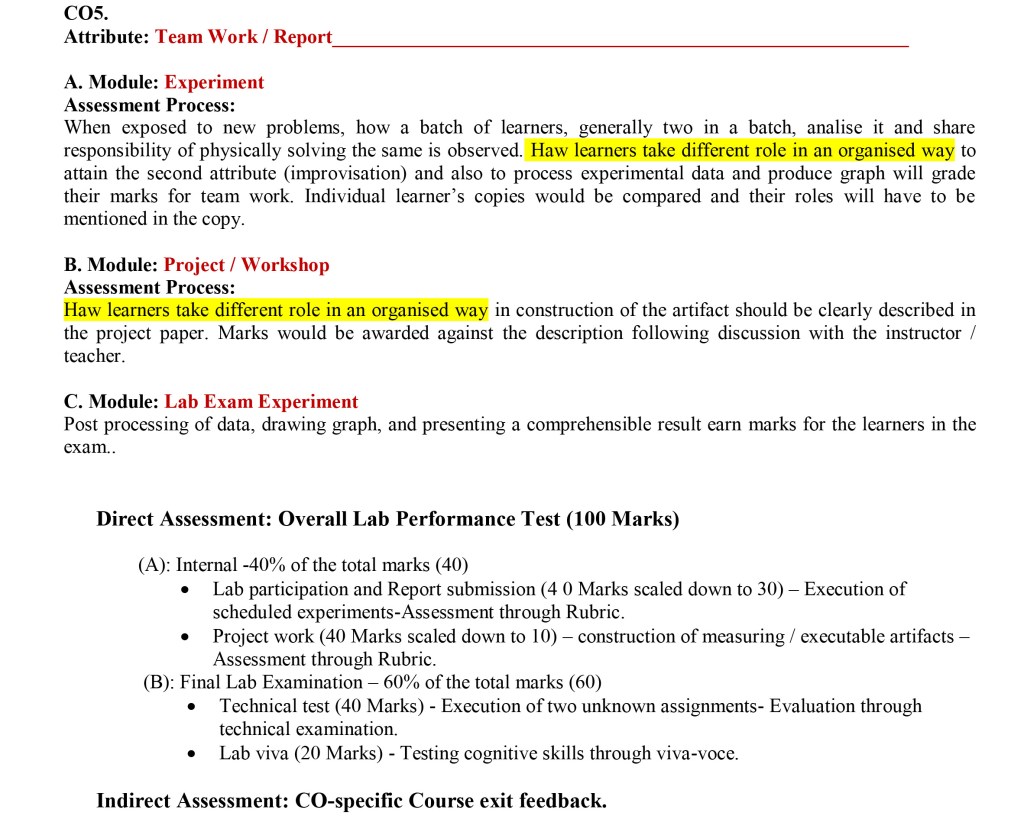
Rubric for Continual Assessment in the Lab

Marking Table
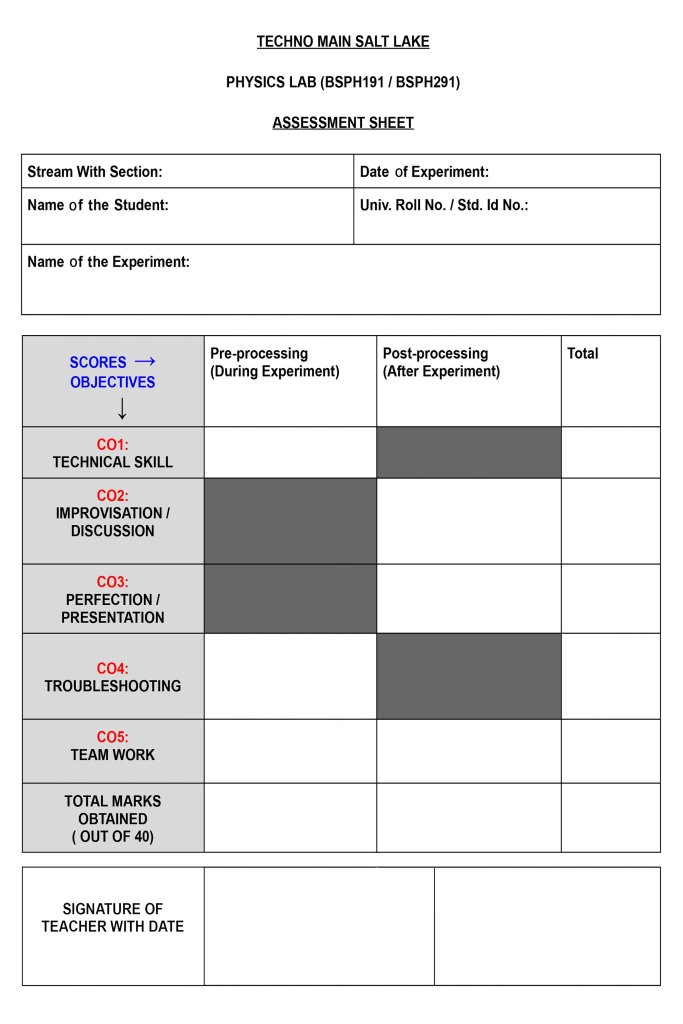
Set of Instruction About Lab Works
How to get access to the necessary documents of Physics Lab:
- Search http://tmphys.tech.blog in google.
- Go to the ‘Study Material’ page. Click the maroon elephant under ‘Material for Practical Papers’. Alternatively click here for the documents.
- After an online drive opens, explore for your necessary files.
How to get prepared for the Physics Lab classes:
- Go to General Files and Read through the Power Point file, Orientation thoroughly. If any question, ask your teacher.
- Open the Work Chart and know your scheduled experiment numbers according to your batch number.
- Open List of Experiments and Go to the folder Working Manuals and open the necessary file according to your batch number.
- Arrange the following items to bring in the class:
- A pack of interleave sheets without cover
- Ten sheets of 1 mm type graph paper (250 mm by 200 mm)
- A scientific calculator
- A one foot long scale, not a smaller one.
- Pen
- Pencil
- Eraser
- A plastic envelop.
- The Marking Table
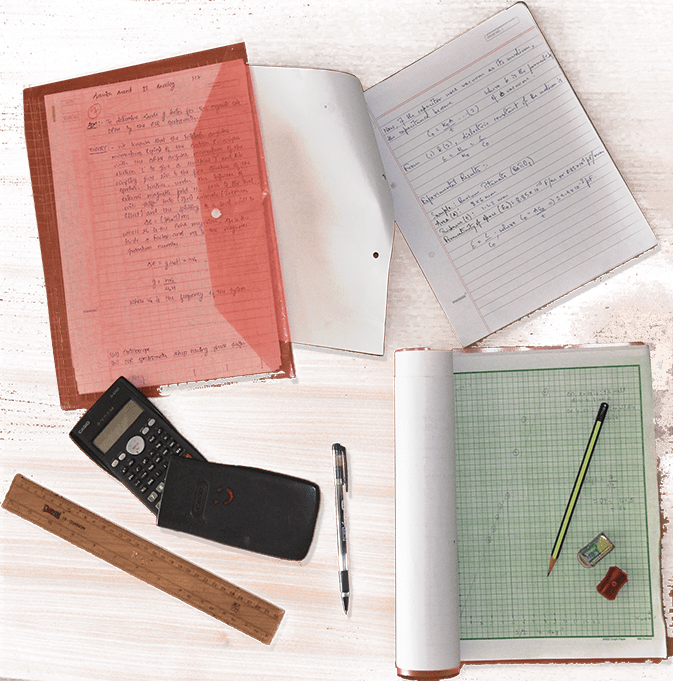
- At the top of the first ruled page of the interleaved sheet write the aim of the experiment.
- At the middle, write the working formula in brief and mention the meaning of the symbols.
- On the back of the first page draw the circuit diagram if any.
- From the second ruled page continue with everything under the heading of ‘Experimental Results’.
- Keep enough space in the tables (make extra rows) to accommodate cancellation.
- Reading the full manual come prepared with all these steps in the class.
What to do in the classes:
- Keep your bags in the specified racks in the corridor. Do not keep bags on experimental tables. Do not touch any apparatus before demonstration.
- Submit a stapled bunch of your previous worksheets (if any) During attendance. Keep photographs of those sheets before submitting.
- After attendance and demonstration by your teachers or lab assistants handle your apparatus with care and take data on the drawn tables of proper interleave sheets using a pen.
- Using a pencil, some spare paper or some whitener in data taking will cause cancellation of your work.
- You or your teacher can use the blank sides of the interleave sheets for anything necessary for the work like taking notes, drawing for your understanding or any calculation etc. Nothing should be done as casual or done on other sheets.
- If any student in the class is caught having any image, soft copy or hard copy of another student’s practical work then their class would be cancelled.
- After completion of data taking come to your teacher for verification and a signature. If you leave the room without a signature on the data taken, your work would be discarded. Produce the marking table for getting marks.
- Continue with calculation and graph. Never show any calculation inside a table. Any pending job would be treated as homework.
- Come to your teacher for any assistance regarding the homework before the day of the next experiment. Write your own opinion and suggestion, any new idea, improvisation, discussion etc. about the experiment in a few short points on the interleave sheets. You can search in the internet for the same purpose.
- Buy a transparent envelope folder. On each day of experiment, before attendance, submit the stapled bunch of sheets of the previous experiment inserted within the envelope folder that is labeled with your name, section, roll number, stream and year. At the end of the semester, this envelop folder will contain all your experimental works.
- If any individual student be absent in the class keep the skipped experiment aside for some time until the day of repeat / revision class. After absence come prepared with the next allotted experiment.
Data Generated for the Individual Students
In outcome based education system evaluation of students’ activity is a continual process. In and outside of the classes, numerus activities generate huge data. Every student has the right to get access to her own data set. For this purpose online drives are used in the department. Here is the entry to the data pool concerned with the department.

 Physics TMSL